
The fitness industry has an incredible ability to take something simple and make it look like you need a degree in circus performance to do it properly.
Core training is a perfect example.
I’m a big fan of strengthening your core. In fact, you’ll find plenty of direct core work in the workouts on this very site.
What I’m not a fan of, however, is the idea that every exercise suddenly becomes better if we perform it while wobbling around on an unstable surface.
You’ve probably seen this stuff before.
Squats on BOSU balls. Presses on Swiss balls. People standing on one leg while simultaneously trying to curl a dumbell, balance a kettlebell and presumably summon the ghost of Joseph Pilates himself.
And it’s usually accompanied by the same explanation:
“It engages your core more, bro.”
But does it?

What happens when you squat on an unstable surface?
A 2013 study published in the Journal of Strength and Conditioning Research put this idea to the test.
Researchers had 15 healthy men perform maximum-effort isometric squats using four different surfaces:
- Normal stable floor
- BOSU ball
- Power board
- Balance cone
They measured both force output and muscle activity throughout the legs and trunk.
If instability really makes a squat better by forcing your muscles to work harder, you’d expect the unstable versions to perform rather well.
They didn’t.
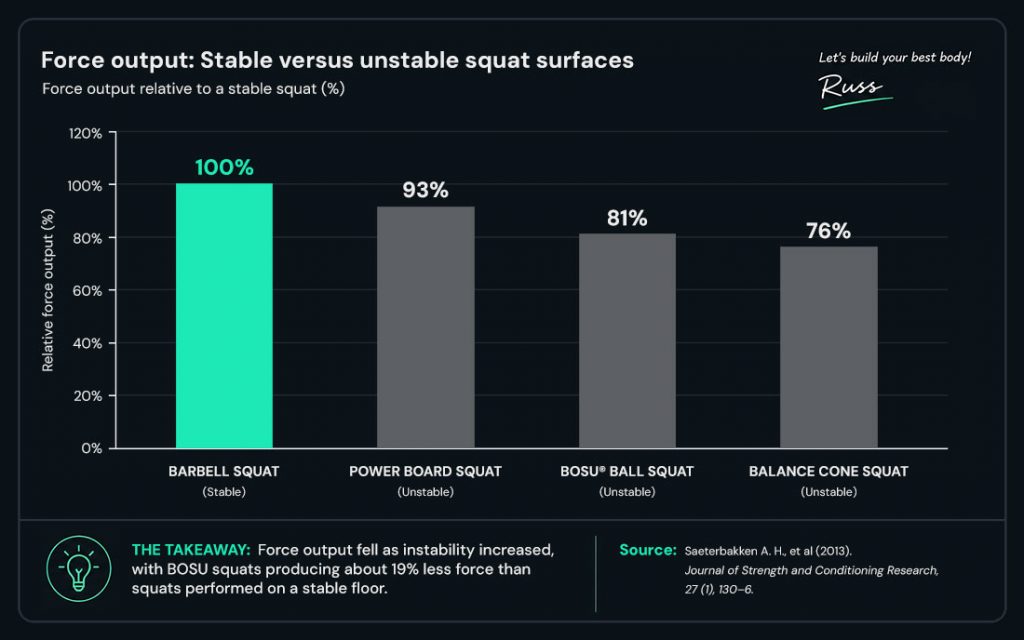
Compared with the stable squat, force output was approximately:
- Stable floor — 100%
- Power board — 93%
- BOSU Ball — 81%
- Balance cone — 76%
The BOSU squat reduced force output by around 19%, while the balance cone reduced it by 24%. (1)
Here’s the really interesting part…
Despite making the exercise substantially less stable, muscle activity in the superficial trunk muscles was generally similar between all of the different surfaces.
In other words, the trainees became worse at producing force — without receiving some magical explosion in “core activation” to compensate.
The rectus femoris was actually the exception: it showed greater activity during the stable squat than during the unstable variations.
That doesn’t mean BOSU balls are useless.
The researchers themselves pointed out that unstable surfaces could have applications in rehabilitation or as part of a periodised training programme for athletes, where producing muscular activity with lower external forces might actually be very useful.
But that’s very different from telling a healthy trainee:
“Take your normal squat and put it on a BOSU ball because it works your core harder.”
The evidence from this study simply doesn’t support that claim.
Your regular strength exercises already train your core
This is the part which often gets forgotten.
Your core doesn’t switch off because both feet happen to be touching the floor.
Heavy compound exercises require the muscles surrounding your trunk to stabilise your spine and transfer force while the rest of your body is moving.
And there’s another study which demonstrates this rather nicely.
Researchers at the University of Salford compared trunk-muscle activity during several exercises, including the prone bridge, Superman, back squat, front squat, and military press.
Ten recreationally trained men performed the dynamic exercises using s standardised 40kg load, while EMG was used to measure activity in the rectus abdominis and erector spinae. (2)
One particulary useful comparison was:
Barbell front squats versus Superman on a Swiss ball.
If you’ve ever performed a Superman on a Swiss ball, you’ll know it certainly feels like a serious core exercise.
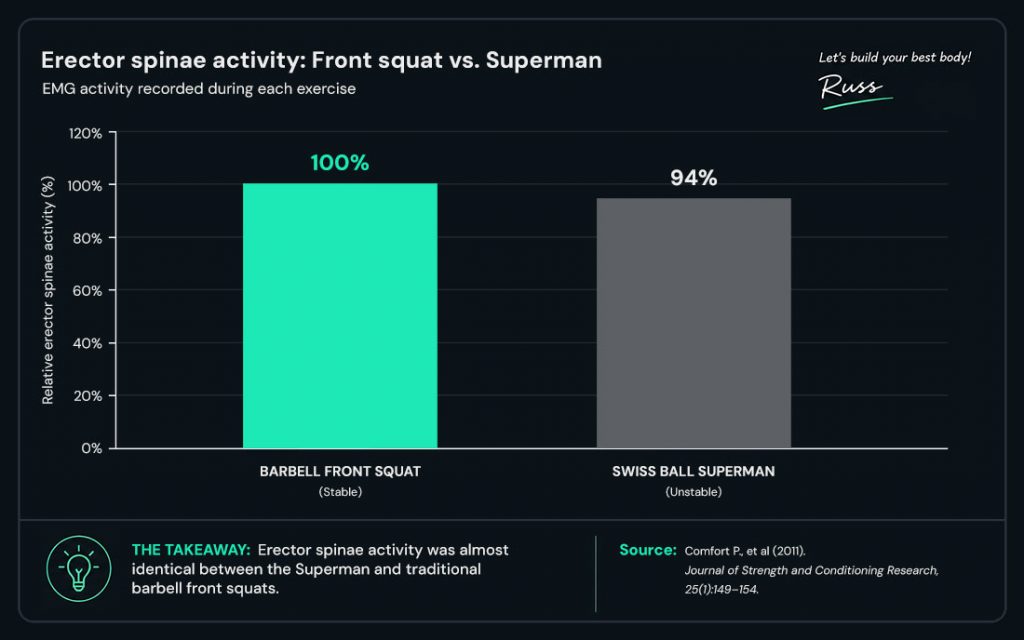
Yet average erector-spinae activity was actually slightly higher during the front squat:
- Front squat — 1.010 RMS
- Superman — 0.951 RMS
That works out at roughly a 6% difference.
Now, there’s an important bit of context here.
The difference between those two exercises was not statistically significant, so it would be wrong to claim that the study proved front squats activate the erector spinae more than Supermans.
But what it does show is something arguably more useful:
A fairly ordinary front squat produced erector-spinae activity comparable to a dedicated trunk-strengthening exercise.
And remember, this wasn’t some monster five-rep-max squat — it was 40kg.
That’s a pretty good reminder that your core is already doing plenty of work during properly performed compound lifts.
So do you still need direct core exercises?
Absolutely, if you want them.
This isn’t an argument for deleting planks, rollouts, Supermans, or other direct core exercises from your programme.
In fact, the same 2011 study found that the prone bridge produced significantly greater rectus-abdominis activity than every other exercise tested. Different exercises can emphasise different functions and different muscles.
The point is much simpler:
You don’t need to deliberately make your major strength exercises worse in order to train your core.
If your goal is to build strength and muscle, there’s a very good reason exercises such as squats, deadlifts, rows and presses are normally performed from a stable surface: it allows you to produce more force and progressively load the movement.
Then, if you want to add additional core work, just add it.
This would give you the best of both worlds, instead of turning one good exercise into a considerably wobblier one.
Complexity isn’t the same thing as effectiveness
There’s something strangely convincing about an exercise that looks difficult to perform.
If somebody is shaking violently on top of a BOSU ball while holding a pair of dumbbells, our brains naturally assume something impressive must be happening.
Sometimes it is.
Sometimes they’re just making an ordinary exercise unnecessarily shit.
The 2013 study is a great example. Increasing instability reduced the amount of force the participants could produce without generally increasing activation of the trunk muscles.
That’s not an upgrade if your primary goal is getting stronger.
So by all means train your core. Use planks, rollouts, loaded carries, and whatever appropriate exercises fit your programme and goals. And if unstable-surface training has a specific purpose in your rehabilitation or training plan, there may be perfectly good reasons to use that too.
But the next time you hear about replacing proven strength exercises with circus tricks because they’ll “engage your core more” from some unqualified influencer with whiter teeth than 1999 Ross Gellar, you’ll know better.
Now go train.

References
Research behind this article.
Want to dig into the evidence? The studies referenced throughout this article are listed below.
View references — 2 studies
- Saeterbakken A. H., et al. Muscle force output and electromyographic activity in squats with various unstable surfaces. J Strength Cond Res (2013).
- Comfort C., et al. An electromyographical comparison of trunk muscle activity during isometric trunk and dynamic strengthening exercises. J Strength Cond Res (2011).