Join 127,111 others on my e-mail list for FREE fitness advice:

training to failure

Does Training To Failure Lead To More Muscle Growth?

Some coaches believe you should always keep 3-4 reps in the tank, and some coaches believe you should train your muscles to failure…

… but who is right?

Well, research indicates that if your goal is to build muscle then you ought to be training to failure on a regular basis.

Because when this technique is applied correctly it can significantly improve your results, and have your pals asking what the hell you’re doing (or using!) to see such progress.

However, when it is applied poorly, it can be a serious waste of fucking time (or worse, it can lead to injury).

I’ll break it down for you below.

A woman doing a set of pull ups to failure

What Is Training To Failure?

This is when we take a muscle to the stage of point where we cannot perform another good rep.

For example, if you’re doing a set of 8-12 reps you’ll be struggling to get the weights through a full range of motion towards the end. That’s considered “failure”.

We can also apply this method to high rep work, so if you’re shooting for 20-30 reps, think of the moment where “the burn” kicks in and you’re forced to quit. That’s failure.

Does training to failure build muscle?

How Does It Help You Build More Muscle?

Doing this creates a larger anabolic response, leading to more muscle growth.

You’ll see a spike in certain anabolic hormones (testosterone, cortisol, growth hormone, and insuline-like growth factor-1) which play a key role in the post-workout muscle recovery process. (10)

This net result is a superior environment for muscle growth.

training_to_failure

Let’s Look At The Science

The first study to show the benefits of training to failure actually did it by accident!

Back in 2010, a team of researchers from McMaster University, Canada, set out to discover the different anabolic responses of lifting a heavy weight with low volume versus lifting light weights for high volume, so they had trainees doing this:

  • Group A: 4 sets of 4-5 reps
  • Group B: 4 sets of 20-30 reps
  • Group C: 4 sets of 20-30 reps with an easy weight (control group)

In terms of the research they were looking for, Group B saw greater muscle protein synthesis than Group A so this was the first study to show that higher rep ranges can be very useful for building muscle, but they also discovered that Group C (the control group who did not train to failure) achieved much worse results than either! (1)

One year later, researchers from the same university decided to do a follow-up study on using high rep training and it once again highlighted some useful information with regards to training to failure.

The methodology was the same:

  • Group A: 4 sets of 4-5 reps
  • Group B: 4 sets of 20-30 reps
  • Group C: 4 sets of 20-30 reps with an easy weight (control group)

Amazingly, the researchers were able to duplicate the findings of first study, but this time the researchers made a note of the fact that instructing trainees (both low reps and high reps) to use a weight which took them to failure played a key role in their results, whereas group C (trainees who did not train to failure) got the worst results again. (2)

“Our results suggest that resistance exercise performed to failure confers a sensitizing effect on human skeletal muscle for at least 24 h that is specific to the myofibrillar protein fraction.”

So now we had two studies suggesting that training to failure leads to superior muscle growth.

This led to further, more in-depth enquiries into the topic.

Because, strangely, even though these studies told us a lot about the benefits of training to failure, they weren’t actually set up with this particular goal in mind. If we are to investigate the subject more thouroughly we would need a study which showed:

  • Muscle measurements
  • Longer period of time
  • Having trainees hit the exact same rep range with weights which cause failure or no failure

Thankfully we got all of these answers in a great study which was published in 2012!

This time around, trainees were classified as:

  • Group A: 3 sets of 12 leg extensions with 30% max weight
  • Group B: 3 sets of 12 leg extensions with 30% max weight and slow lifting tempo

Even though both groups were using a relatively light weight, the slower tempo ensured that Group B were able to achieve failure due to the increased time spent under tension. This led to them achieving significantly better results, finally confirming what many bodybuilders have believed for decades – training to failure IS GREAT for building muscle! (3)

A woman performing a set of dumbbell rows to failure.

How Often Should You Go To Failure?

So now that we know training to failure can help us build more muscle, let’s look at how often we should do it.

Is it best to do it on every set?

Or how about every few sets?

Or maybe just once per workout?

An interesting 2012 study published in the Journal of Applied Physiology set out to answer this question. They had trainees doing one of the following:

  • Group A: 1 set to failure of 8-12 reps
  • Group B: 3 sets to failure of 8-12 reps
  • Group C: 3 sets to failure of 20-30 reps

All participants used weights which took them to failure for the prescribed number of reps, but notice how Group A only failed once, whereas Group B and Group C failed three times, with heavy weights and light weights respectively. Over the course of a 10-week program we saw these groups achieve much better results, which suggests that not only do we want to train to failure, but that we want to do it quite often! (4)

Now, it’s important to mention that I’m not saying you should train to failure on every set.

Heck, you’d likely be gassed within 15 minutes of your workout starting!

Also, we must remember that warm-up sets play an equally important role in the muscle building process, because they help us to “grease the groove” and set the stage for your maximum effort sets which come later on, so do not remove these sets from your workout.

However, we DO want to reach failure on multiple occasions throughout our session, because this has been shown to create the best results.

I like to do this by working through a series of regular sets, where the goal is to increase your weights as you go, and then arrive at an apex set – and if you still energy left you can really squeeze every last drop of effort by using one of my “muscle buster” techniques, such as a dropset, or a rest pause set.

This structure gets you to failure while also helping you to achieve progressive overload, and should help you to unlock some impressive muscle building results.

Job done!

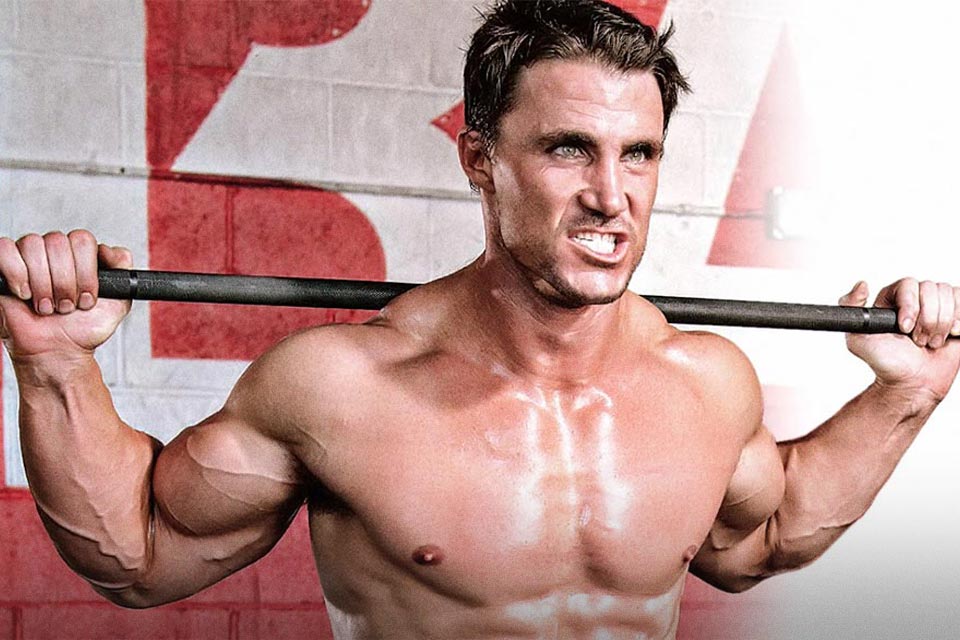
Greg Plitt trained to failure to build muscle and burn fat.

NOTE: High Rep Sets Are A Different Beast

High rep sets MUST be taken to failure if we want to build muscle.

It’s that simple.

During the avalanche of studies which landed in the 2010s showing us that high rep sets can be useful for building muscle, it’s worth knowing that every single one of them had trainees going to failure.

In fact, there’s not a single study (ever!) where trainees were able to build muscle via high rep work without training to failure!

That’s because proper high rep training relies on something called The Size Principle; a “biological rule” which dictates that the body will always recruit muscle fibres from smallest-to-biggest in an attempt to conserve energy. (9)

We can exploit this to maximize our results.

If you were to perform a low rep set with a heavy weight, the body would utilize its fast-twitch muscle fibres (the large muscle fibres which are associated with greater explosive strength), but if during a high rep set with a lighter weight the body would use its slow-twitch muscle fibres (smaller and weaker fibres associated with endurance). This explains why, as a general rule, lifting heavy weights for a low number of reps is the primary way to build muscle. (5, 6)

However, when we take our high rep sets to failure this unlocks a new muscle building pathway!

To explain how this works, let’s take a look at exactly what happens to your muscles during a set…

When you pick up a weight, we know that The Size Principle is going to dictate that your body attempts to recruit the slow-twitch musle fibres first, because these require less energy.

If they cannot get the job done (e.g. because the weight is too heavy) the body will quickly switch to nearby fast-twitch muscle fibres and you’ll complete the set.

(Of course, all of this happens within a micro-second!)

Meanwhile, if you perform a high rep set (15-30 reps), The Size Principle once again dictates that your body will recruit slow-twitch muscle fibres at first, but this time they can actually do the job because the weight is significantly lighter. When we take our high rep set to failure these muscle fibres will start to fatigue and the body will respond by recruiting all of the nearby fast-twitch muscle fibres to help you keep pushing out reps, until you’ve got nothing left in the tank.

So by the end of that set you’ve fully exhausted both types of muscle fibres, and that’s how high rep training creates muscle growth! (7, 8)

A bodybuilder training to muscle failure

How To Train “Beyond” Failure

I know that title makes no sense, but let me land this.

There are several techniques which can help you push beyond the point which you consider “failure”, and this can result in an even bigger spike in those all-important muscle building hormones.

I call them “Muscle Buster” techniques.

As mentioned earlier, we apply them after the final set of an exercise to make sure there’s absolutely nothing left in the tank. Doing this enables you to unlock the benefits of training to failure alongside the benefits of progressive overload, which is “muscle building heaven”!

This is how to do it:

  • Set 1 is used to grease the groove, so to speak.
  • Set 2 and set 3 are where we look to increase the weight as much as possible.
  • Set 4 is where you peak in terms of weight lifted, and then we apply a “Muscle Buster” straight after to ensure there’s nothing left.

Training like this will help you achieve vastly superior results, and will have others in your local gym questions what the fuck you’re doing (or what the fuck you’re taking) to see such good results!

Jim Stoppani discusses the benefits of training to failure

“The further you can take your final set beyond failure, the higher you can increase levels of natural muscle building hormones like testosterone and cortisol, and therefore, the more you can push muscle growth.”

– Dr. Jim Stoppani

Here are some of my favourite “Muscle Buster” techniques:

  • Dropsets

Perform your final set of an exercise then immediately lighten the weight by about 30% and continue squeezing out reps to failure. Job done. Dropping the weight by this amount should let you achieve almost the same number of reps you hit in your final set. (11)

  • Rest Pause

Complete your final set, then rest for a 10-count, and then see if you can squeeze out a few more reps (same weight). Your muscles can replenish phosphocreatine very quickly, and the Rest Pause technique allows you to take advantage of that, so you should be able to hit 4-5 more reps even though you only rested 10 seconds. (12)

  • Forced Reps

Your ability to perform forced reps at the end of your final set depends on you having a training partner. When you reach the point of failure, have your partner help you to perform a few extra reps. Research from Finland shows that this technique can increase the number of fast-twitch muscle fibres which are recruited, versus stopping at traditional muscle failure. (13)

  • Negative Reps

This one’s a little different, because we don’t use it after our final set of an exercise. Instead, we just introduce this method into our training plan on certain exercises (barbell curls works well) every couple of months. You’ll load the bar with a slightly heavier weight than you’d usually lift and have your partner assist you through the lifting phase (e.g. curling a barbell), and then you control the negative phase (e.g. lowering the curl) by yourself. Most of the muscle building benefits occur during the negative phase, so this technique allows you to overload the segment of the exercise which yields the biggest bang for your buck. However, it will take a toll on your recovery time (and the DOMS can be insane!), so it’s a method best used sparingly. If you train by yourself (like me), you can modify this technique by performing the lifting phase on your own and then controlling the negative for a 5-count. (14)

All of these “Muscle Buster” techniques will make your muscles feel like they’ve been punched in the face with a 5-sided fistagon. Now you know about the benefits of training to failure, it’s time for you to get in the gym!

russhowepti.com

Further Reading:

If you enjoyed this blog, then you’ll probably also like reading these.

>> High Reps Vs Low Reps
>> How To Use Periodization
>> The Rules To Ripped

References:

  1. Burd N. A., et al. Low-Load High Volume Resistance Exercise Stimulates Muscle Protein Synthesis More Than High-Load Low Volume Resistance Exercise In Young Men. PLoS ONE (2010).
  2. Burd N. A., et al. Enhanced Amino Acid Sensitivity Of Myofibrillar Protein Synthesis Persists For Up To 24 Hours After Resistance Exercise In Young Men. J Nutr (2011).
  3. Burd N. A., et al. Muscle Time Under Tension During Resistance Exercise Stimulates Differential Muscle Protein Sub-Fractional Synthetic Responses In Men. J Physiol (2012).
  4. Mitchell C. J., et al. Resistance exercise load does not determine training-mediated hypertrophic gains in young men. J Appl Physiol (2012).
  5. Wackerhage H., et al. Stimuli and sensors that initiate skeletal muscle hypertrophy following resistance exercise. J Appl Physiol (1985).
  6. Peterson M. D., et al. Progression of volume load and muscular adaptation during resistance exercise. Eur J Appl Physiol (2014).
  7. Tee J. C., et al. Metabolic consequences of exercise-induced muscle damage. Sports Med (2007).
  8. Schoenfeld B. J., et al. The mechanisms of muscle hypertrophy and their application to resistance training. J Strength Cond Res (2010).
  9. Henneman E. Relation between size of neurons and their susceptibility to discharge. Science (1957).
  10. Krzysztofik M., et al. Maximizing Muscle Hypertrophy: A Systematic Review of Advanced Resistance Training Techniques and Methods. Int J Environ Res Public Health (2019).
  11. Fink J., et al. Effects of drop set resistance training on acute stress indicators and long-term muscle hypertrophy and strength. J Sports Med Phys Fitness (2018).
  12. Marshall P. W. M., et al. Acute neuromuscular and fatigue responses to the rest-pause method. J Sci Med Sport (2012).
  13. Ahtaianen J. P., et al. Acute hormonal and neuromuscular responses and recovery to forced vs maximum repetitions multiple resistance exercises. Int J Spors Med (2003).
  14. Dannecker E. A., et al. Effect of eccentric strength testing on delayed-onset muscle pain. J Strength Cond Res (2005).

russ howe pti programs

Comments

Leave a Reply

Your email address will not be published. Required fields are marked *

More posts

training to failure

Does Training To Failure Lead To More Muscle Growth?

Some coaches believe you should always keep 3-4 reps in the tank, and some coaches believe you should train your muscles to failure…

… but who is right?

Well, research indicates that if your goal is to build muscle then you ought to be training to failure on a regular basis.

Because when this technique is applied correctly it can significantly improve your results, and have your pals asking what the hell you’re doing (or using!) to see such progress.

However, when it is applied poorly, it can be a serious waste of fucking time (or worse, it can lead to injury).

I’ll break it down for you below.

A woman doing a set of pull ups to failure

What Is Training To Failure?

This is when we take a muscle to the stage of point where we cannot perform another good rep.

For example, if you’re doing a set of 8-12 reps you’ll be struggling to get the weights through a full range of motion towards the end. That’s considered “failure”.

We can also apply this method to high rep work, so if you’re shooting for 20-30 reps, think of the moment where “the burn” kicks in and you’re forced to quit. That’s failure.

Does training to failure build muscle?

How Does It Help You Build More Muscle?

Doing this creates a larger anabolic response, leading to more muscle growth.

You’ll see a spike in certain anabolic hormones (testosterone, cortisol, growth hormone, and insuline-like growth factor-1) which play a key role in the post-workout muscle recovery process. (10)

This net result is a superior environment for muscle growth.

training_to_failure

Let’s Look At The Science

The first study to show the benefits of training to failure actually did it by accident!

Back in 2010, a team of researchers from McMaster University, Canada, set out to discover the different anabolic responses of lifting a heavy weight with low volume versus lifting light weights for high volume, so they had trainees doing this:

  • Group A: 4 sets of 4-5 reps
  • Group B: 4 sets of 20-30 reps
  • Group C: 4 sets of 20-30 reps with an easy weight (control group)

In terms of the research they were looking for, Group B saw greater muscle protein synthesis than Group A so this was the first study to show that higher rep ranges can be very useful for building muscle, but they also discovered that Group C (the control group who did not train to failure) achieved much worse results than either! (1)

One year later, researchers from the same university decided to do a follow-up study on using high rep training and it once again highlighted some useful information with regards to training to failure.

The methodology was the same:

  • Group A: 4 sets of 4-5 reps
  • Group B: 4 sets of 20-30 reps
  • Group C: 4 sets of 20-30 reps with an easy weight (control group)

Amazingly, the researchers were able to duplicate the findings of first study, but this time the researchers made a note of the fact that instructing trainees (both low reps and high reps) to use a weight which took them to failure played a key role in their results, whereas group C (trainees who did not train to failure) got the worst results again. (2)

“Our results suggest that resistance exercise performed to failure confers a sensitizing effect on human skeletal muscle for at least 24 h that is specific to the myofibrillar protein fraction.”

So now we had two studies suggesting that training to failure leads to superior muscle growth.

This led to further, more in-depth enquiries into the topic.

Because, strangely, even though these studies told us a lot about the benefits of training to failure, they weren’t actually set up with this particular goal in mind. If we are to investigate the subject more thouroughly we would need a study which showed:

  • Muscle measurements
  • Longer period of time
  • Having trainees hit the exact same rep range with weights which cause failure or no failure

Thankfully we got all of these answers in a great study which was published in 2012!

This time around, trainees were classified as:

  • Group A: 3 sets of 12 leg extensions with 30% max weight
  • Group B: 3 sets of 12 leg extensions with 30% max weight and slow lifting tempo

Even though both groups were using a relatively light weight, the slower tempo ensured that Group B were able to achieve failure due to the increased time spent under tension. This led to them achieving significantly better results, finally confirming what many bodybuilders have believed for decades – training to failure IS GREAT for building muscle! (3)

A woman performing a set of dumbbell rows to failure.

How Often Should You Go To Failure?

So now that we know training to failure can help us build more muscle, let’s look at how often we should do it.

Is it best to do it on every set?

Or how about every few sets?

Or maybe just once per workout?

An interesting 2012 study published in the Journal of Applied Physiology set out to answer this question. They had trainees doing one of the following:

  • Group A: 1 set to failure of 8-12 reps
  • Group B: 3 sets to failure of 8-12 reps
  • Group C: 3 sets to failure of 20-30 reps

All participants used weights which took them to failure for the prescribed number of reps, but notice how Group A only failed once, whereas Group B and Group C failed three times, with heavy weights and light weights respectively. Over the course of a 10-week program we saw these groups achieve much better results, which suggests that not only do we want to train to failure, but that we want to do it quite often! (4)

Now, it’s important to mention that I’m not saying you should train to failure on every set.

Heck, you’d likely be gassed within 15 minutes of your workout starting!

Also, we must remember that warm-up sets play an equally important role in the muscle building process, because they help us to “grease the groove” and set the stage for your maximum effort sets which come later on, so do not remove these sets from your workout.

However, we DO want to reach failure on multiple occasions throughout our session, because this has been shown to create the best results.

I like to do this by working through a series of regular sets, where the goal is to increase your weights as you go, and then arrive at an apex set – and if you still energy left you can really squeeze every last drop of effort by using one of my “muscle buster” techniques, such as a dropset, or a rest pause set.

This structure gets you to failure while also helping you to achieve progressive overload, and should help you to unlock some impressive muscle building results.

Job done!

Greg Plitt trained to failure to build muscle and burn fat.

NOTE: High Rep Sets Are A Different Beast

High rep sets MUST be taken to failure if we want to build muscle.

It’s that simple.

During the avalanche of studies which landed in the 2010s showing us that high rep sets can be useful for building muscle, it’s worth knowing that every single one of them had trainees going to failure.

In fact, there’s not a single study (ever!) where trainees were able to build muscle via high rep work without training to failure!

That’s because proper high rep training relies on something called The Size Principle; a “biological rule” which dictates that the body will always recruit muscle fibres from smallest-to-biggest in an attempt to conserve energy. (9)

We can exploit this to maximize our results.

If you were to perform a low rep set with a heavy weight, the body would utilize its fast-twitch muscle fibres (the large muscle fibres which are associated with greater explosive strength), but if during a high rep set with a lighter weight the body would use its slow-twitch muscle fibres (smaller and weaker fibres associated with endurance). This explains why, as a general rule, lifting heavy weights for a low number of reps is the primary way to build muscle. (5, 6)

However, when we take our high rep sets to failure this unlocks a new muscle building pathway!

To explain how this works, let’s take a look at exactly what happens to your muscles during a set…

When you pick up a weight, we know that The Size Principle is going to dictate that your body attempts to recruit the slow-twitch musle fibres first, because these require less energy.

If they cannot get the job done (e.g. because the weight is too heavy) the body will quickly switch to nearby fast-twitch muscle fibres and you’ll complete the set.

(Of course, all of this happens within a micro-second!)

Meanwhile, if you perform a high rep set (15-30 reps), The Size Principle once again dictates that your body will recruit slow-twitch muscle fibres at first, but this time they can actually do the job because the weight is significantly lighter. When we take our high rep set to failure these muscle fibres will start to fatigue and the body will respond by recruiting all of the nearby fast-twitch muscle fibres to help you keep pushing out reps, until you’ve got nothing left in the tank.

So by the end of that set you’ve fully exhausted both types of muscle fibres, and that’s how high rep training creates muscle growth! (7, 8)

A bodybuilder training to muscle failure

How To Train “Beyond” Failure

I know that title makes no sense, but let me land this.

There are several techniques which can help you push beyond the point which you consider “failure”, and this can result in an even bigger spike in those all-important muscle building hormones.

I call them “Muscle Buster” techniques.

As mentioned earlier, we apply them after the final set of an exercise to make sure there’s absolutely nothing left in the tank. Doing this enables you to unlock the benefits of training to failure alongside the benefits of progressive overload, which is “muscle building heaven”!

This is how to do it:

  • Set 1 is used to grease the groove, so to speak.
  • Set 2 and set 3 are where we look to increase the weight as much as possible.
  • Set 4 is where you peak in terms of weight lifted, and then we apply a “Muscle Buster” straight after to ensure there’s nothing left.

Training like this will help you achieve vastly superior results, and will have others in your local gym questions what the fuck you’re doing (or what the fuck you’re taking) to see such good results!

Jim Stoppani discusses the benefits of training to failure

“The further you can take your final set beyond failure, the higher you can increase levels of natural muscle building hormones like testosterone and cortisol, and therefore, the more you can push muscle growth.”

– Dr. Jim Stoppani

Here are some of my favourite “Muscle Buster” techniques:

  • Dropsets

Perform your final set of an exercise then immediately lighten the weight by about 30% and continue squeezing out reps to failure. Job done. Dropping the weight by this amount should let you achieve almost the same number of reps you hit in your final set. (11)

  • Rest Pause

Complete your final set, then rest for a 10-count, and then see if you can squeeze out a few more reps (same weight). Your muscles can replenish phosphocreatine very quickly, and the Rest Pause technique allows you to take advantage of that, so you should be able to hit 4-5 more reps even though you only rested 10 seconds. (12)

  • Forced Reps

Your ability to perform forced reps at the end of your final set depends on you having a training partner. When you reach the point of failure, have your partner help you to perform a few extra reps. Research from Finland shows that this technique can increase the number of fast-twitch muscle fibres which are recruited, versus stopping at traditional muscle failure. (13)

  • Negative Reps

This one’s a little different, because we don’t use it after our final set of an exercise. Instead, we just introduce this method into our training plan on certain exercises (barbell curls works well) every couple of months. You’ll load the bar with a slightly heavier weight than you’d usually lift and have your partner assist you through the lifting phase (e.g. curling a barbell), and then you control the negative phase (e.g. lowering the curl) by yourself. Most of the muscle building benefits occur during the negative phase, so this technique allows you to overload the segment of the exercise which yields the biggest bang for your buck. However, it will take a toll on your recovery time (and the DOMS can be insane!), so it’s a method best used sparingly. If you train by yourself (like me), you can modify this technique by performing the lifting phase on your own and then controlling the negative for a 5-count. (14)

All of these “Muscle Buster” techniques will make your muscles feel like they’ve been punched in the face with a 5-sided fistagon. Now you know about the benefits of training to failure, it’s time for you to get in the gym!

russhowepti.com

Further Reading:

If you enjoyed this blog, then you’ll probably also like reading these.

>> High Reps Vs Low Reps
>> How To Use Periodization
>> The Rules To Ripped

References:

  1. Burd N. A., et al. Low-Load High Volume Resistance Exercise Stimulates Muscle Protein Synthesis More Than High-Load Low Volume Resistance Exercise In Young Men. PLoS ONE (2010).
  2. Burd N. A., et al. Enhanced Amino Acid Sensitivity Of Myofibrillar Protein Synthesis Persists For Up To 24 Hours After Resistance Exercise In Young Men. J Nutr (2011).
  3. Burd N. A., et al. Muscle Time Under Tension During Resistance Exercise Stimulates Differential Muscle Protein Sub-Fractional Synthetic Responses In Men. J Physiol (2012).
  4. Mitchell C. J., et al. Resistance exercise load does not determine training-mediated hypertrophic gains in young men. J Appl Physiol (2012).
  5. Wackerhage H., et al. Stimuli and sensors that initiate skeletal muscle hypertrophy following resistance exercise. J Appl Physiol (1985).
  6. Peterson M. D., et al. Progression of volume load and muscular adaptation during resistance exercise. Eur J Appl Physiol (2014).
  7. Tee J. C., et al. Metabolic consequences of exercise-induced muscle damage. Sports Med (2007).
  8. Schoenfeld B. J., et al. The mechanisms of muscle hypertrophy and their application to resistance training. J Strength Cond Res (2010).
  9. Henneman E. Relation between size of neurons and their susceptibility to discharge. Science (1957).
  10. Krzysztofik M., et al. Maximizing Muscle Hypertrophy: A Systematic Review of Advanced Resistance Training Techniques and Methods. Int J Environ Res Public Health (2019).
  11. Fink J., et al. Effects of drop set resistance training on acute stress indicators and long-term muscle hypertrophy and strength. J Sports Med Phys Fitness (2018).
  12. Marshall P. W. M., et al. Acute neuromuscular and fatigue responses to the rest-pause method. J Sci Med Sport (2012).
  13. Ahtaianen J. P., et al. Acute hormonal and neuromuscular responses and recovery to forced vs maximum repetitions multiple resistance exercises. Int J Spors Med (2003).
  14. Dannecker E. A., et al. Effect of eccentric strength testing on delayed-onset muscle pain. J Strength Cond Res (2005).

Comments

Leave a Reply

Your email address will not be published. Required fields are marked *

More posts

Join 127,111 others on e-mail list for FREE fitness advice: